
Professional services firms have a particular relationship with credibility. The whole business model depends on it. A law firm, an accounting practice, a management consulting firm — what they’re actually selling isn’t a product or a feature set. It’s expertise, judgment, and trustworthiness. The question clients are really asking when they evaluate these firms isn’t “what can you do” but “should I trust you with this.”
That credibility-first model makes professional services firms simultaneously well-positioned for GEO and somewhat behind in adopting it. Well-positioned because genuine expertise is exactly what AI systems are trying to surface. Behind because professional services marketing has historically been conservative, relationship-driven, and skeptical of digital channels in ways that have slowed adoption of new approaches.
The firms that bridge that gap — that take their genuine expertise and make it structurally legible to AI systems — are building competitive advantages that will compound for years.
How AI Systems Evaluate Professional Services Firms
When someone asks an AI tool to recommend accounting firms specializing in real estate investment, or law firms known for employment litigation, or consulting practices with healthcare expertise, the AI is drawing on signals across the web to construct that recommendation.
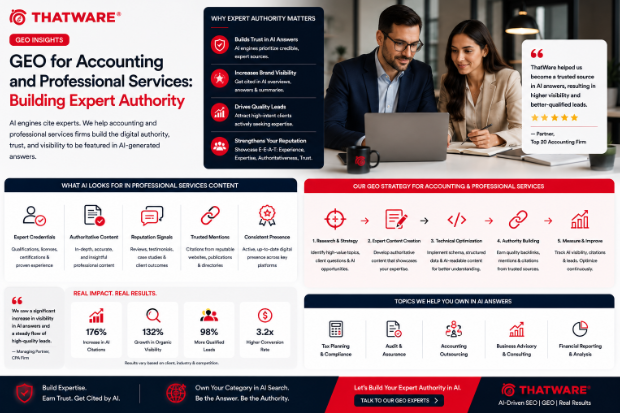
It’s not purely random, and it’s not just picking whoever has the highest domain authority. It’s looking for: consistent evidence of expertise in the specific domain (content, case studies, speaking engagements, media coverage), named individuals with verifiable credentials and publication histories, third-party validation from credible sources (client testimonials, awards, analyst recognition, media profiles), and clean entity signals that connect the firm’s name to its area of practice.
Most professional services firms have real expertise in abundance. The gap is usually in making that expertise legible to AI systems — which requires a combination of content work, entity optimization, and earned media building that many firms haven’t yet prioritized.
Thought Leadership That Translates to AI Authority
Professional services firms often produce thought leadership — client newsletters, white papers, conference presentations, practice alerts. The challenge is that most of it is produced for client audiences and distributed through channels (direct mail, email, controlled events) that don’t generate the web-accessible citation signals AI systems draw from.
For GEO purposes, the same expertise needs to be published in formats and on platforms that AI systems can access and reference. That means:
Public-facing content on your website with proper schema markup, clear author attribution, and specific, substantive positions on the issues you’re known for. Not vague thought leadership. Real takes on real problems, written by named experts with verifiable credentials.
Contributed articles in authoritative industry publications. For accounting and professional services, this might be publications like Accounting Today, Journal of Accountancy, The American Lawyer, Consulting Magazine, or relevant trade publications for your specific industry focus. Being consistently bylined in these publications builds the external citation footprint that AI systems recognize.
Quoted commentary in business and general media. Journalists covering tax, regulatory, or business strategy topics regularly look for expert sources. A firm whose partners are regularly quoted in authoritative media — not just obscure trades — builds a different AI authority profile than one that doesn’t engage with media at all.
Entity Optimization for Professional Services
Best GEO agencies for B2B / SaaS / eCommerce have increasingly developed practice area expertise for professional services specifically — because the entity optimization challenges here are distinct.
Professional services firms often have entity structure complexity: a main firm entity, multiple practice groups that function somewhat independently, dozens of individual professional entities (partners and principals who each have their own reputation and authority). Getting the entity hierarchy right — ensuring that individual partner authority feeds up into firm authority, and that practice group positioning is clearly connected to the firm’s overall brand — requires thoughtful architecture.
Individual partner profiles on the firm’s website need to be treated as entity pages, not just bio blurbs. Name, credentials, specific areas of practice, publications, speaking history, notable matters (where appropriate) — all of this feeds into the personal authority signals that AI systems use when recommending firms for specific expertise.
LinkedIn profiles for individual professionals are particularly important in this category. AI systems draw on LinkedIn data significantly, and a professional with a sparse or outdated LinkedIn presence is a missed opportunity for entity authority building.
Practice Area Content Architecture
One of the most impactful GEO moves for professional services firms is developing genuine topical depth for each practice area — not just a practice area landing page, but a full content architecture that establishes the firm as a genuine reference source for questions in that domain.
This means: foundational explainer content (“what is X” and “how does X work” for the core concepts in your practice area), FAQ content addressing common client questions, analysis of regulatory and legal developments with clear expert attribution, case examples illustrating how you’ve approached specific challenges (within confidentiality constraints), and resource guides for clients navigating specific situations.
The firms that do this well essentially become the reference destination for their practice areas — which is exactly the positioning that drives AI citations when someone asks “what firm should I talk to about [specific issue in your practice area].”
Client Evidence and Social Proof
Professional services firms are sometimes reluctant to publish client case studies for confidentiality reasons. That’s understandable. But there are approaches to building client evidence that work within those constraints.
Anonymized case studies that describe the type of client, the challenge, and the outcome without identifying specifics are standard practice and AI-friendly. Client testimonials — even general ones — on your website and on platforms like Google Reviews or industry-specific review sites contribute to social proof signals. Speaking engagements where clients discuss their experience publicly (with their permission) generate citable content.
GEO optimization services for professional services firms typically spend meaningful time on the client evidence layer because it’s often the weakest link in an otherwise strong expertise profile.
The Referral Network Connection
Professional services business development has historically run on referral networks — other professionals, former clients, and peer relationships directing business based on trusted recommendations. AI tools are essentially a scaled, automated version of the same process: synthesizing the available evidence to recommend who to trust.
This framing can make GEO less foreign to professional services partners who are skeptical of digital marketing. You’re not doing something alien to how your business has always worked. You’re making sure that the expertise and reputation you’ve built is visible to the mechanism that an increasing share of client research is running through.
The firms that see GEO as an extension of reputation building — rather than a departure from it — tend to engage with it more effectively and more sustainably.
In professional services, expertise has always been the product. GEO is simply about making sure the systems your future clients are using to find expertise can see yours clearly.
